A family resemblance, not a clean dividing line
Bluegrass and country are not opposites. Bluegrass grew within the wider world of country music, drawing on fiddle tunes, old-time string bands, gospel singing and other American musical traditions. Country is a broader label: it can describe a spare acoustic performance, a honky-tonk band, a polished studio recording or many sounds in between. That overlap is why a song can belong comfortably on both a bluegrass record and a country record.
The most useful distinction is often the arrangement rather than the lyric or the artist’s identity. Both styles tell stories about work, travel, love and loss. Both can feature a fiddle, a guitar and a memorable chorus. To hear what makes a performance lean toward bluegrass, pay attention to how the musicians share the rhythm and how frequently the melody passes from one instrument to another.
The instruments: an acoustic core and a wider palette
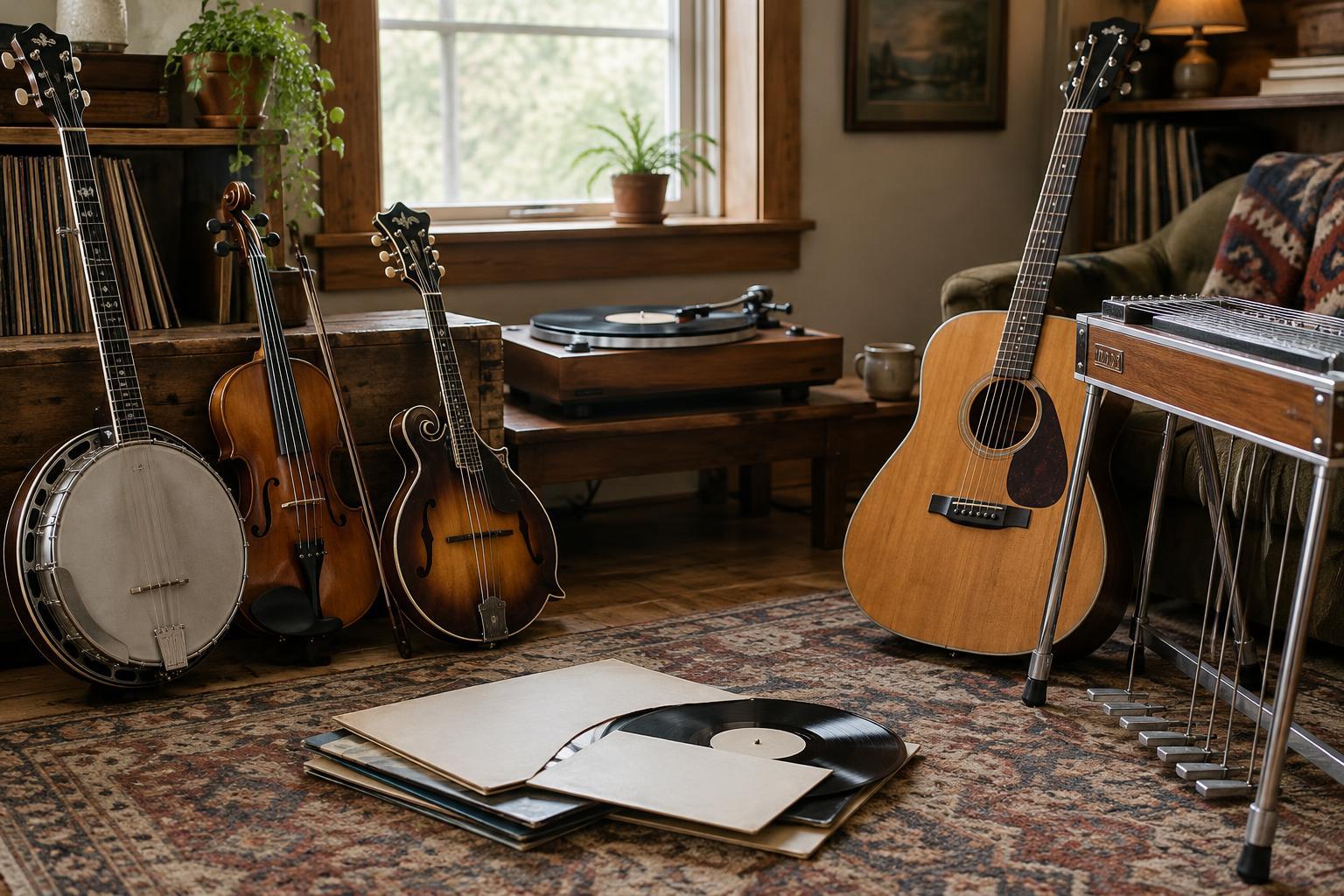
A familiar bluegrass lineup brings together acoustic guitar, banjo, mandolin, fiddle and upright bass. A resonator guitar, often called a dobro, may add sliding notes. The bass marks a steady pulse; the guitar supplies chords and rhythm; the mandolin can deliver a short, sharp offbeat chop. Over that foundation, the banjo, fiddle, mandolin, guitar or dobro may take a turn carrying the tune. Not every bluegrass group uses every instrument, but this division of musical jobs is a useful listening cue.
Country music has a much wider instrumental palette. Depending on the recording, you might hear acoustic or electric guitar, fiddle, piano, drums, electric bass or pedal steel guitar. A country arrangement may place the singer in front of a full rhythm section, with instrumental phrases answering the vocal lines. Electric instruments or drums do not make a song less country; they simply point away from the acoustic string-band sound often associated with bluegrass.
Instrument names alone can mislead. A fiddle can drive a bluegrass breakdown or color a country ballad. A resonator guitar can appear in either setting. Instead of identifying one sound and stopping there, listen to the whole ensemble: is it built around tightly interlocking acoustic parts, or does it use a broader band or studio arrangement?
Song forms: verses, choruses and room for breaks
Both bluegrass and country songs may use verses and a repeated chorus. Neither genre is defined by a single chord pattern or song form. A narrative country song might keep returning to a strong vocal hook, while a bluegrass song might move between sung verses, a chorus and instrumental breaks. Traditional tunes can also appear as instrumentals, giving each player a chance to state or vary the melody.
In bluegrass, a break is more than a short decoration between lines. One instrument often steps forward for a substantial passage while the others keep the rhythm moving. Another player may then take a turn over the same tune or chord sequence. Country songs can feature memorable solos too, but a recording may instead emphasize the vocal performance, the lyric’s progression or the contrast between verse and chorus.
Try following the melody through one complete track. Does it return mostly in the singer’s voice, or does it travel through several instruments? That question is more revealing than trying to classify a song from its opening few seconds.
Playing styles and vocal character
Bluegrass is often associated with a quick, driving feel, though it also includes slower songs. A three-finger banjo roll can keep notes flowing; a mandolin chop can make the offbeats feel crisp; and a fiddle or flatpicked guitar can turn a familiar melody into a nimble solo. Good ensemble playing leaves space for each part while making the rhythm feel continuous, even without a drum kit.
Close vocal harmony is another common bluegrass feature. Voices may enter together on a chorus, with a higher part adding intensity above the lead. The phrase “high lonesome” is sometimes used for a piercing, plaintive vocal sound, but it is not a test every bluegrass singer must pass. Country vocals are just as varied: they may be conversational, restrained or forceful, and the arrangement can give a singer more space to deliver a lyric.
Tempo and polish are unreliable shortcuts. A country band can play fast, and a bluegrass group can sound carefully arranged. Listen instead for the combination of rhythmic roles, vocal blend and the way players trade musical ideas.
A practical way to compare records
If you are exploring either style on vinyl, compare two tracks at a comfortable volume rather than looking for a perfect genre boundary. On each record, note what establishes the beat, which instrument answers the singer and whether a solo develops into a full break. Listen again for the chorus: does the energy come from stacked voices, a fuller band arrangement or both?
Record sleeves and track lists can offer useful clues about players and instruments, but your ears should have the final say. A country record may feature a bluegrass-style passage, and a bluegrass group may reshape a song familiar from country radio. Those crossings are part of the pleasure of collecting: instead of filing every record into a rigid category, you can hear how musicians give shared material a distinct character.