What these accessories actually do
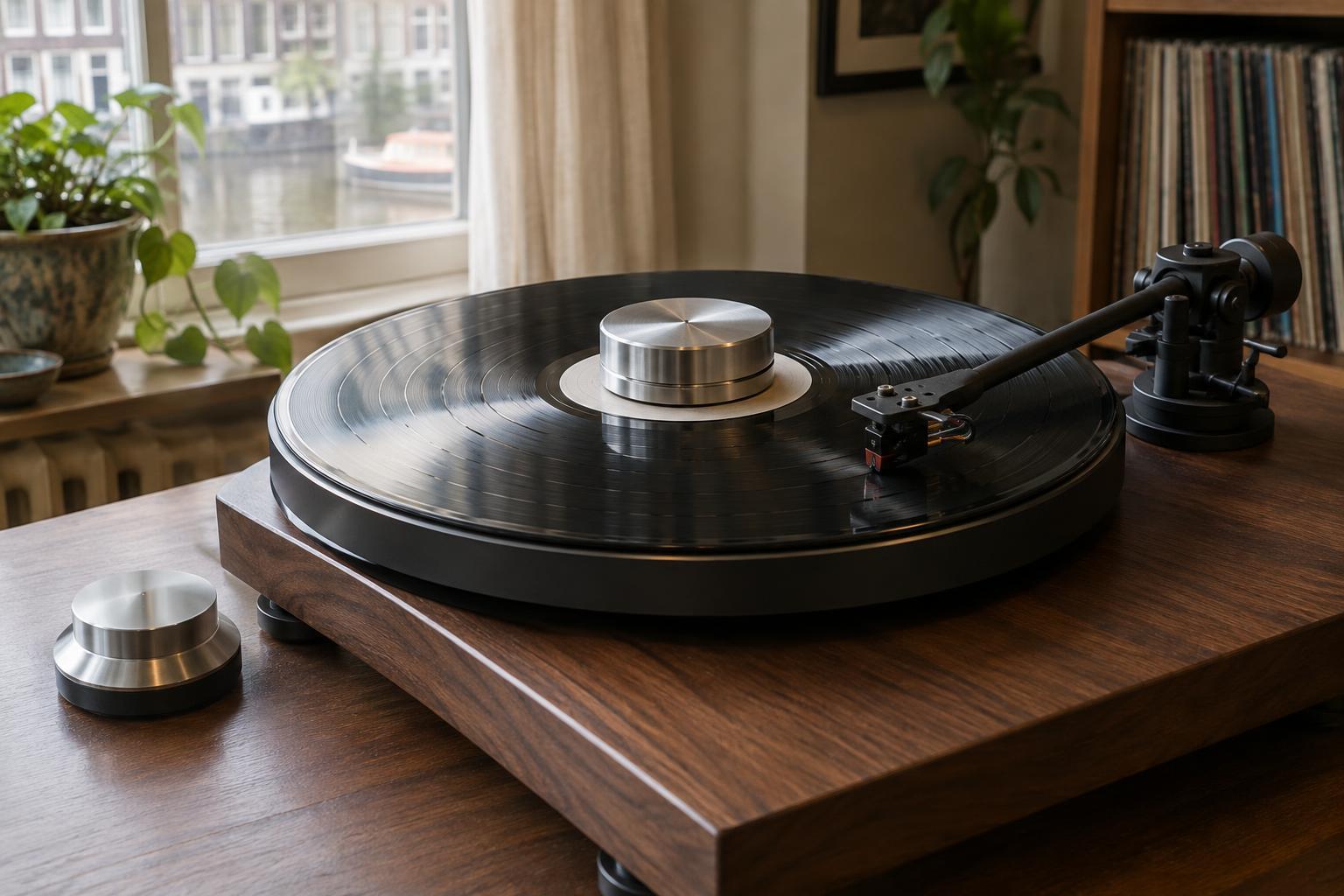
A record weight sits over the spindle and holds the record down through its own mass. A clamp grips the spindle and applies downward pressure without necessarily adding much weight. Both aim to improve contact between the record and the platter or mat. Neither changes the grooves, repairs damage or guarantees better sound.
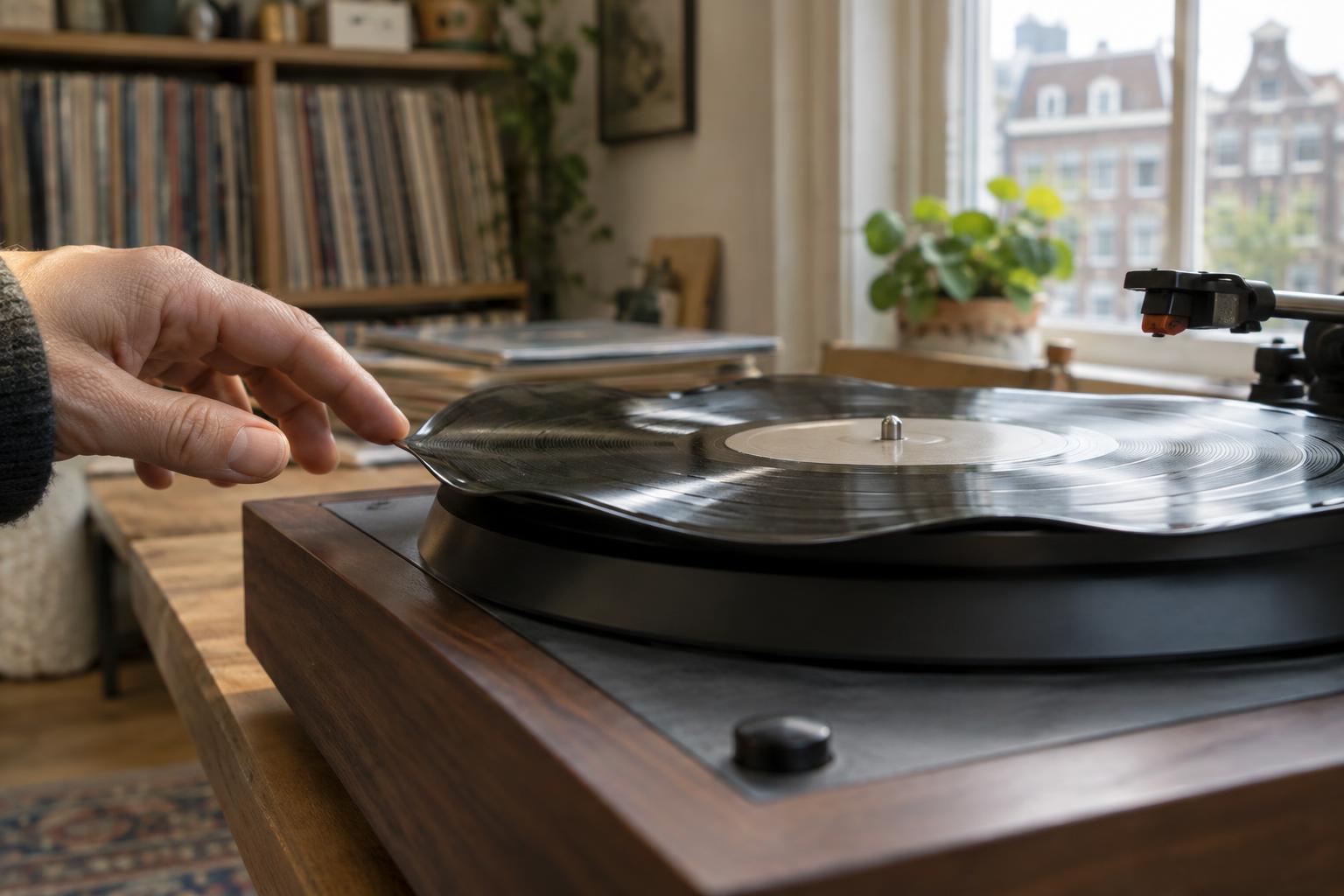
Their most visible effect may be on a slightly dished record: one side sits higher at the edge when placed on a flat surface. Depending on the platter, mat and accessory, pressure near the label can help the record sit more evenly. Results vary because the pressure is concentrated around the center. A clamp or weight may do little for a sharp warp near the outer grooves, and it cannot make a badly warped record safe to play.
If your records already lie flat and play cleanly, there may be no practical reason to add anything. Listen for a specific problem rather than assuming that heavier contact always produces an improvement.
Check the turntable before choosing one
Start with the turntable maker’s guidance, if available. A heavy weight adds load to the platter bearing, while a clamp may pull against the spindle or platter assembly. This matters especially on a suspended turntable, where extra mass can alter the suspension’s height or behavior. An accessory that suits one deck may be a poor match for another.
Check the physical fit as well. The spindle must be tall enough for the accessory to engage securely above a record. A clamp must grip without requiring excessive force, and its design must suit the spindle. Consider whether the dust cover can close without touching it; if not, leave the cover open during playback rather than forcing it. Make sure the accessory stays clear of the tonearm and cartridge throughout their travel.
A weight and a clamp are alternatives, not items you need to stack. If the turntable’s documentation gives no useful guidance on added load, a lightweight clamp may be worth considering before a substantial weight—but only if its gripping action is compatible with the deck. When in doubt, using neither is the safer choice.
Test for a benefit without changing everything at once
Choose a clean record you know well, ideally one with a mild, visible dish rather than a severe warp. First play a passage without the accessory. Note whether the record sits securely, whether the cartridge tracks normally and whether you hear a repeatable problem. Stop the platter, add the clamp or weight, then replay the same passage at the same listening level. Keep the mat, tracking force and other settings unchanged so you can judge this one difference.
Watch the record as well as listening to it. Does it sit more evenly? Does the tonearm still move freely? If the difference is hard to hear or see, there is no need to persuade yourself that it is there. Small variations between plays can make comparisons tricky, so a second trial is more useful than a quick impression.
Do not use extra pressure to chase a flatter appearance. A record that makes the stylus rise and fall sharply, or that skips repeatedly, calls for caution. Set it aside rather than treating a clamp or weight as a way to force playback.
Use it gently—and know when to look elsewhere
Handle the accessory with the platter stopped. Place a weight straight down over the spindle; lower a clamp and secure it only as its design intends. Avoid dragging either across the label or letting it fall onto the record. Before starting playback, confirm that the record and accessory are centered and stable. Remove the accessory before lifting the record.
A clamp or weight is unlikely to solve skipping caused by a dirty groove, an unstable turntable support, an incorrect tracking-force setting or a worn stylus. If many records show the same problem, investigate the playback setup rather than buying an accessory for each symptom. If only one record is affected, inspect that record first.
The useful question is not whether every vinyl listener should own a clamp or weight. It is whether a compatible accessory improves a particular record on your particular turntable without creating a new problem. For an otherwise reliable setup, the simplest choice may be to leave the platter as it is.