Start with the pulse, not a single instrument
Cumbia is a family of dance music rather than one fixed arrangement. To find its center, listen for a steady pulse that invites a measured, swaying step. Many cumbias can be felt in groups of two or four beats. A low drum or bass marks the ground, while sharper percussion places accents around it. The result can feel relaxed without standing still: small sounds between the main beats keep the rhythm moving.
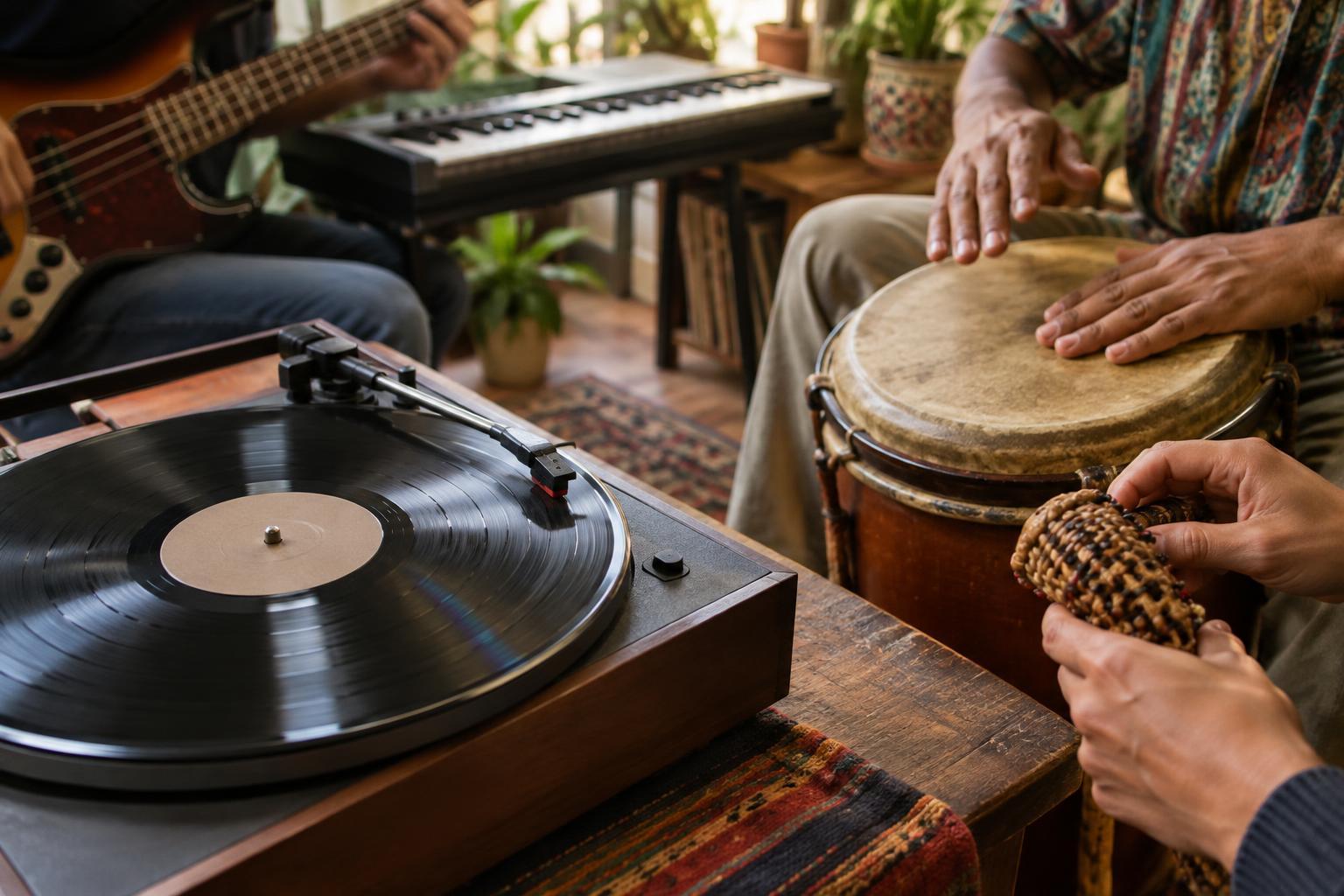
There is no single percussion pattern that every cumbia must follow. A scraper such as the guacharaca may provide a continuous textured rhythm; shakers, hand drums or a drum kit can divide and accent the pulse in other ways. Try listening to one instrument at a time, then notice how the parts fit together. The groove often comes less from a dramatic downbeat than from the conversation between its steady foundation and its lighter, more restless layers.
Colombia: a broad starting point
Cumbia is closely associated with Colombia’s Caribbean coast, where its history reflects interactions among Indigenous, African and European musical traditions. That background does not reduce to a tidy formula, and Colombian cumbia itself comes in different forms. In some ensembles, flutes such as gaitas, drums and shakers carry the melody and rhythm. In others, accordion, brass, electric instruments or fuller dance-band arrangements change the texture.
When listening to a percussion-led recording, follow how the drums answer one another beneath a repeating melody. In a larger-band recording, the same danceable momentum may sit under horns or a prominent bass line. Accordion can feature in Colombian cumbia too, but its presence alone does not make every accordion-led track cumbia; neighboring styles have their own rhythms and identities. Let the beat and the way the ensemble plays it guide your ears.
Mexico: keyboards, sound systems and local scenes
Cumbia has taken many forms in Mexico, so a country label tells only part of the story. Some arrangements favor bright keyboards, brass or electric bass, with percussion that makes the pulse easy to follow on a dance floor. Sonidero culture also places importance on how recordings are selected, played and experienced through a sound system. The social setting can shape what listeners notice as much as the instruments do.
One distinctive listening path is cumbia rebajada, associated especially with Monterrey’s sound-system culture. Slowing a recording changes its pitch and pacing, giving familiar musical parts a heavier, more spacious feel. It is best understood as a particular way of hearing and presenting cumbia, not as the default Mexican rhythm. Compare it with an upbeat keyboard-led track: both may retain a swaying pulse, yet they create strikingly different senses of motion.
Peru and Argentina: new textures around the groove
In Peru, styles often grouped under names such as chicha or Peruvian cumbia brought electric guitar into a prominent melodic role. Repeating guitar phrases, sometimes colored by effects, can wind above bass and percussion. Some recordings also draw on Andean melodic ideas. Listen to how a guitar line cycles while the rhythm section keeps dancers oriented: the melody can be adventurous without losing the underlying sway.
Argentine cumbia likewise covers more than one sound. Keyboard-led dance arrangements can be direct and catchy, while cumbia villera is associated with particular urban scenes and lyrical perspectives as well as musical choices. Lyrics, production and audience matter here; a keyboard timbre alone is not enough to identify a substyle. Across these recordings, compare where the bass lands and how the percussion fills the spaces. Those details reveal both continuity and local character.
A practical way to listen across styles
For a small listening session, choose a few cumbia recordings with contrasting instrumentation rather than looking for one definitive example. On the first play, tap the main pulse. On the second, follow the bass; on the third, focus on the scraper, shaker, drums or programmed percussion. Finally, listen to the melody and ask whether it leads the dance, circles around it or leaves room for the rhythm to take over.
If you are browsing records, check the track itself rather than relying only on a sleeve description or a broad genre bin. A compilation may place very different regional approaches side by side, and artists frequently cross stylistic boundaries. Cumbia’s appeal lies partly in that flexibility: a recognizable rhythmic pull can support flutes, guitars, horns, keyboards or electronic sounds without making those recordings interchangeable.