What a condition grade tells you
Condition grades give buyers and sellers a shared shorthand for a used record’s state. They help distinguish a carefully kept copy from one that has seen heavy use, but they cannot describe every click, mark or worn corner. A grade is most useful when it comes with a clear description of the particular copy.
Many sellers use a scale that runs from Mint through Near Mint, Very Good Plus, Very Good and Good, with lower grades for badly worn or damaged copies. The labels are widely recognisable, but people do not always apply them with the same strictness. One seller’s Very Good Plus may look or sound different from another’s, so read the notes rather than shopping by letters alone.
The common grades, from pristine to well worn
Mint, often written M, suggests an essentially perfect item. For used records, it is a demanding claim: even an unplayed record may have a small manufacturing flaw or storage mark. Near Mint, or NM, usually describes a record that looks exceptionally clean, with little sign of handling. It does not necessarily mean that every pressing will play in absolute silence.
Very Good Plus, or VG+, generally allows light evidence of use, such as faint sleeve marks or minor surface noise, without significant disruption to the music. Very Good, or VG, is a broader and more noticeably used category. You might expect visible marks and audible noise, especially in quiet passages, while the record should still be playable and enjoyable for someone comfortable with those imperfections.
Good Plus and Good, often shown as G+ and G, do not mean “good as new.” They usually signal substantial wear and more persistent noise; scratches may be easy to hear. These copies can still appeal when a record is difficult to find or the price reflects its condition. Fair and Poor suggest more serious problems and call for particular caution. Different sellers may draw these boundaries differently, so a description of the defects matters more than the label on its own.
Check the record and the sleeve separately
A record has at least two conditions to consider: the disc and its packaging. Listings often show them as separate grades, such as “VG+/VG,” but check which comes first. A clean disc can sit in a split or heavily worn cover; an attractive cover can hold a noisy disc. For collectors who value artwork, original inserts or tidy shelving, sleeve condition may affect the decision almost as much as playback.
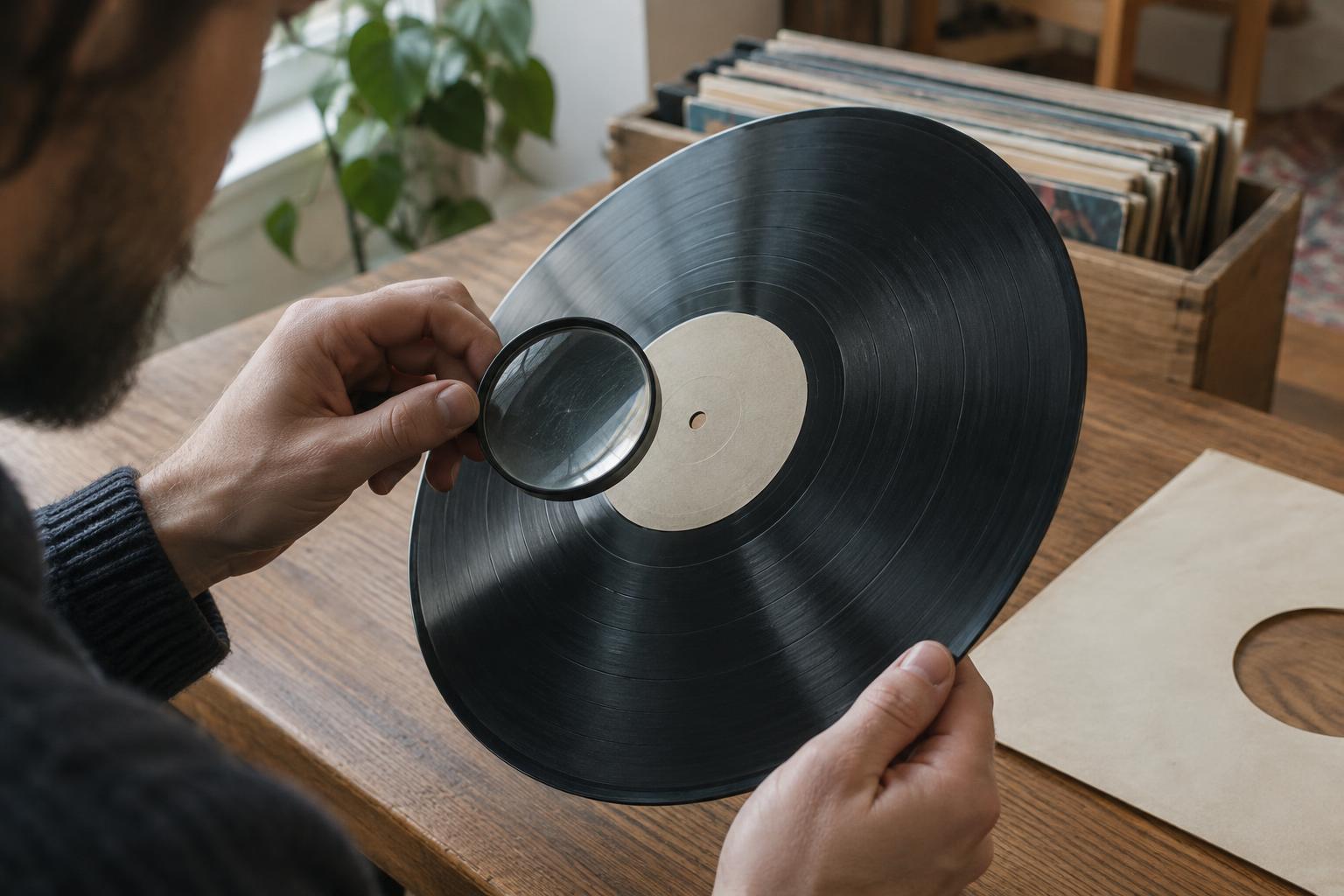
On the disc, look for fine scuffs, deeper scratches, cloudy patches and signs of warping. A hairline mark is not automatically audible, while a small scratch can cause a repeated tick. On the sleeve, check for seam splits, ring wear, writing, stickers, water damage and missing inner sleeves or inserts. These details are more informative than a single overall grade, particularly when buying a higher-priced copy.
Visual grading is not the same as listening
Many records are graded by sight. Under good light, a seller can inspect both sides for wear, but appearances have limits. Dirt can make a record seem worse than it is; a glossy-looking disc can still have groove wear or noise that becomes clear only during playback. Surface noise can also vary between turntables and stylus setups.
If listening matters more to you than appearance, ask whether the seller has play-graded the record. A full play-grade involves listening through both sides; a brief spot-check does not offer the same reassurance. Useful descriptions identify where a problem occurs, such as a recurring tick on one track, rather than saying only that a record “plays fine.” Cleaning may remove dust-related noise, but it will not repair a damaged groove or straighten a warped disc.
Use the grade to make a better buying decision
Before buying online, compare the stated grade with the seller’s specific notes and photos. If an issue could change your decision, ask a focused question: Does the scratch repeat? Is the warp noticeable during playback? Is the original inner sleeve included? Photos taken at an angle under direct light can help reveal marks, though they cannot tell you how a record sounds.
In person, handle a record by its edge and label, and ask before removing it from its sleeve or using a listening station. Give both sides a careful look, then inspect the cover and any inserts. You do not need to reject every imperfect copy: a lower-grade record may be right for casual listening, while a favourite album might be worth seeking in better shape. The goal is not to find a grade that guarantees perfection, but to know which compromises you are willing to accept.