Start with the cartridge, not the counterweight
Tracking force is the downward force a stylus applies to a record while playing. Too little force can make the stylus mistrack or skip; too much can put unnecessary pressure on the stylus and groove. The right target is not a universal number. It comes from the specifications for the cartridge fitted to your turntable.
Identify the cartridge model before adjusting anything. Its name may be printed on the body, though you might need a mirror or a photo to read it without touching the stylus. Check the cartridge documentation for a recommended tracking-force range and, if given, a preferred value. If the cartridge has been replaced since the turntable was bought, use the specifications for the fitted cartridge rather than the turntable’s original setup instructions. Where the model is uncertain, pause rather than choosing a number based on appearance.
Prepare a stable place to measure
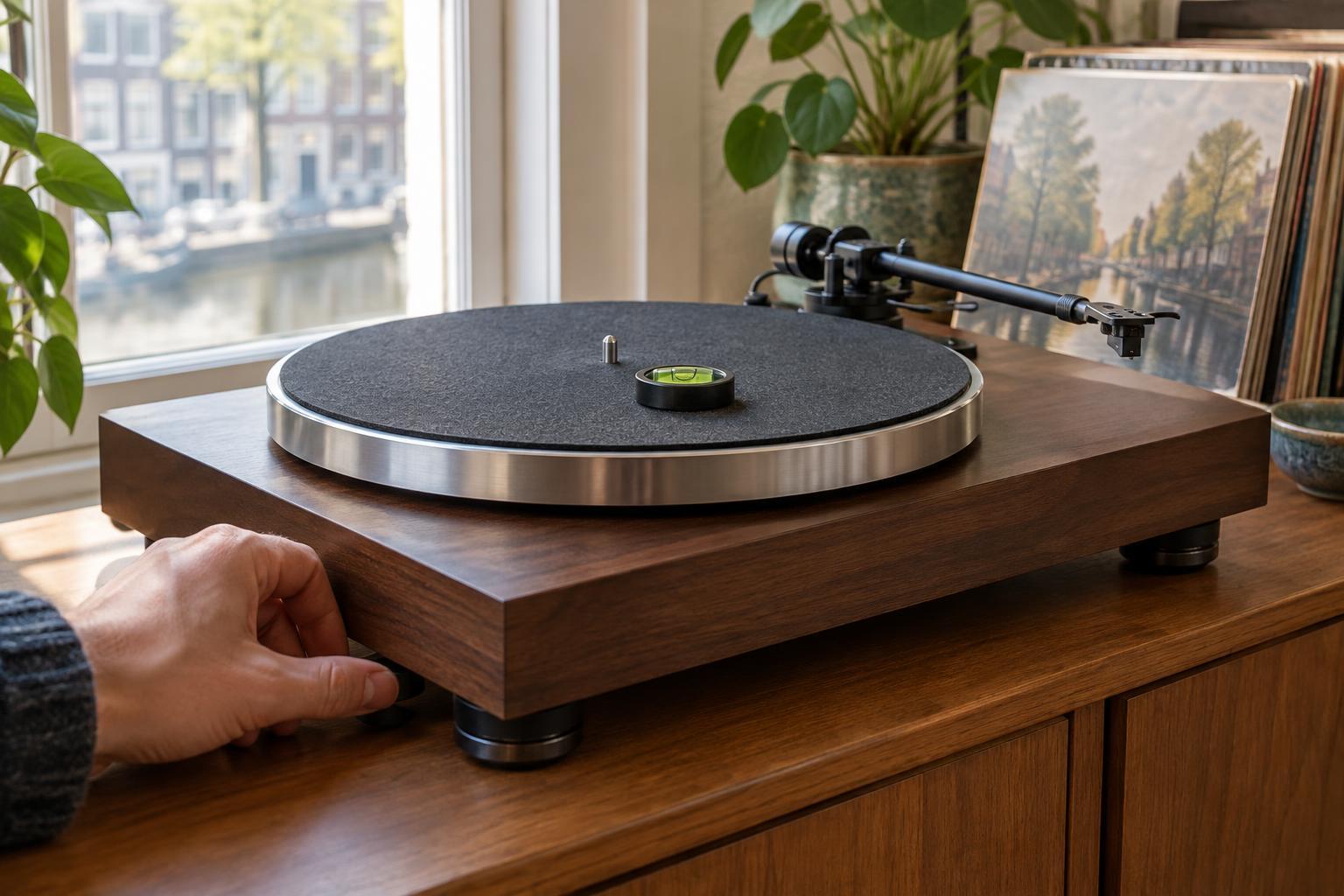
Put the turntable on a stable surface and check that its platter is level. Switch off the motor. Keep the stylus guard in place while moving the arm or handling the counterweight, but remove it before weighing: a guard can change the reading or prevent the stylus from reaching the gauge. Take care not to touch the delicate stylus tip.
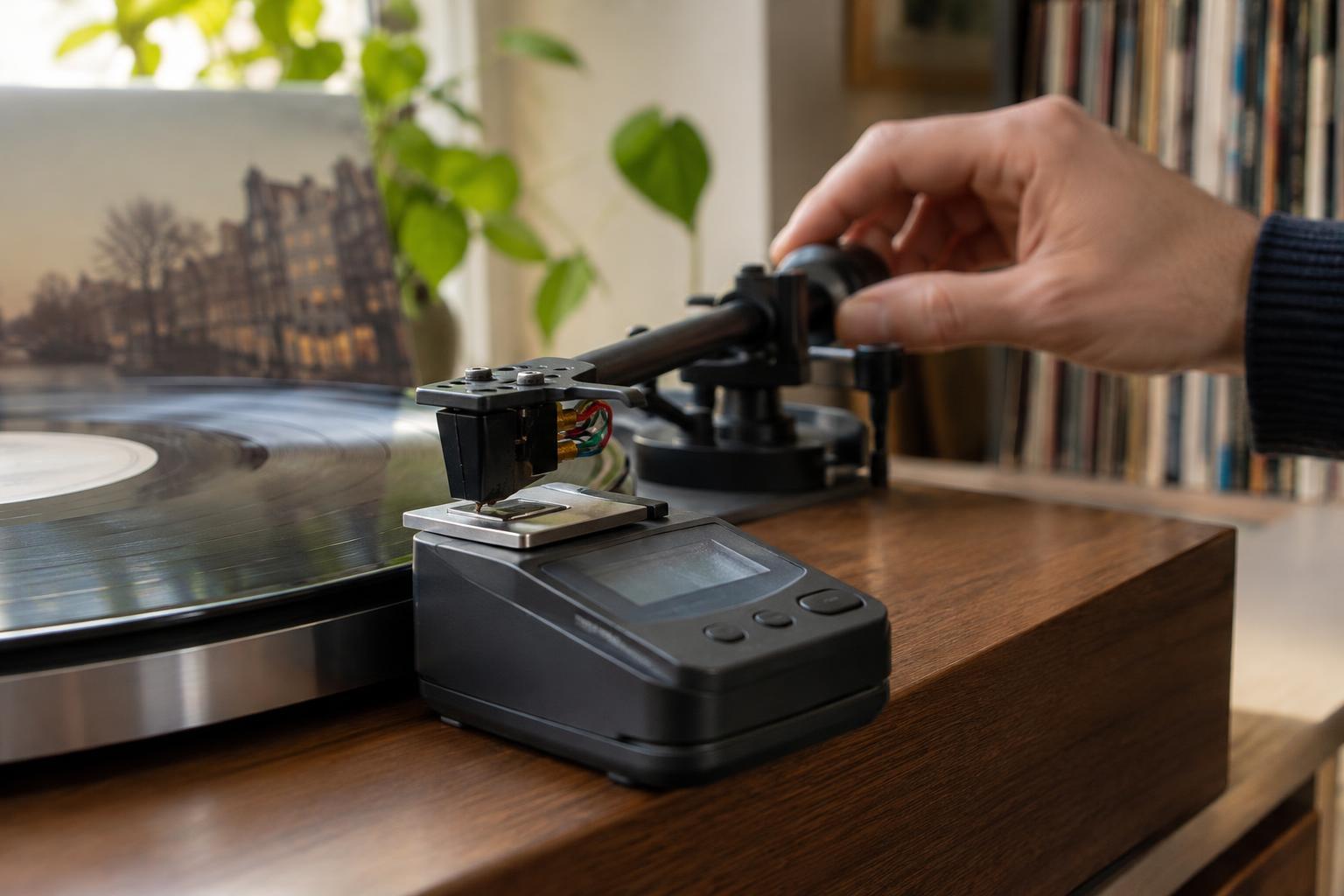
A digital stylus-force gauge makes this job easier because it measures the force where it matters: at the stylus. Follow the gauge’s instructions to switch it on and zero it. If it has a measuring platform, position that platform as close as practical to the height of a record’s playing surface. A large height difference can affect the reading on some tonearms. Keep the gauge clear of the platter spindle and anything else that could stop the arm moving freely.
Set and measure the force
If your tonearm has a movable rear counterweight, begin by following its manual’s balancing procedure. On many arms, this means setting anti-skate to zero, carefully moving the counterweight until the arm floats roughly level, then turning only the numbered dial to zero without moving the weight itself. You can then rotate the counterweight toward the cartridge’s recommended value. This gets you close, but the printed scale is a starting point, not a substitute for measurement. Some arms use a different system, so follow your tonearm’s instructions if this procedure does not match its controls.
With the gauge on the stationary platter, move the tonearm over its measuring point and lower it gently using the cueing lever. Let the stylus rest on the gauge’s designated spot, then read the value once it settles. Lift the arm before changing the counterweight. Small movements can make a noticeable difference, so adjust gradually and measure again until you reach the cartridge’s recommended value or a sensible point within its specified range. Do not push down on the arm to speed up the reading.
Finish the setup and check your work
Once tracking force is set, adjust anti-skate according to your tonearm’s instructions. Some manufacturers suggest starting near the tracking-force value; others provide their own method. Anti-skate is a separate adjustment and cannot be used to correct an unknown tracking force. If you changed anti-skate from its usual setting before balancing the arm, remember to restore it.
Measure the force once more after moving the gauge away and putting it back. Repeated readings should be close; if they vary substantially, check that the gauge is zeroed, the platter is still, and the stylus is landing in the same place each time. Then return to a familiar, clean record at a modest volume. Playback can reveal an obvious setup problem, but a record that sounds fine is not proof that the force is correct. Keep the gauge reading and cartridge specification as your references.
Know when not to force an adjustment
Not every turntable has an adjustable counterweight. Some plug-and-play models have a preset arm, and some tonearms use springs or other mechanisms to apply tracking force. Do not twist a fixed part in search of an adjustment that is not there. Consult the model’s manual to learn what can be changed and how force should be measured.
If the stylus will not rest safely on your gauge, the arm will not balance as described, or the measured force stays outside the cartridge’s range, stop before playing records. Check that the cartridge and counterweight are compatible with the arm and that all fitted parts are secure. A careful measurement takes only a little time, but it gives you a firmer basis for listening than a guess at where the counterweight ought to sit.