What happens when a stereo stylus plays a mono groove?
Most mono LPs and singles can be played on a properly set up stereo turntable. A mono record carries one audio program rather than separate left and right programs. A stereo cartridge can trace the groove and send that program through both channels, so there is no need to replace a working cartridge just because you have brought home a mono pressing.
The distinction is between the record’s audio and the equipment reading it. A stereo cartridge responds to more than the side-to-side groove motion that carries a conventional mono signal. As a result, it may also pick up some noise that differs between channels. That does not make stereo playback wrong; it explains why the same record can sound a little different when the channels are combined properly for mono listening.
Do you need a mono switch?
A mono switch combines the left and right signals into one signal played through both speakers. On a mono record, this can reduce some clicks, surface noise or low-frequency disturbance that appears differently in the two channels. The effect varies with the pressing, its condition and your setup. Try the switch while listening at a comfortable level, and keep whichever setting sounds better.
Your amplifier, receiver or phono stage may already have a mono setting. If it does not, use a device designed to combine the channels at an appropriate point in the signal chain. Do not connect the left and right outputs together with an improvised cable, and never join speaker outputs. A mono switch is for mono playback: turn it off for stereo records unless you have a specific reason to hear them summed, since combining stereo channels can change the mix.
Check the record and stylus before playing
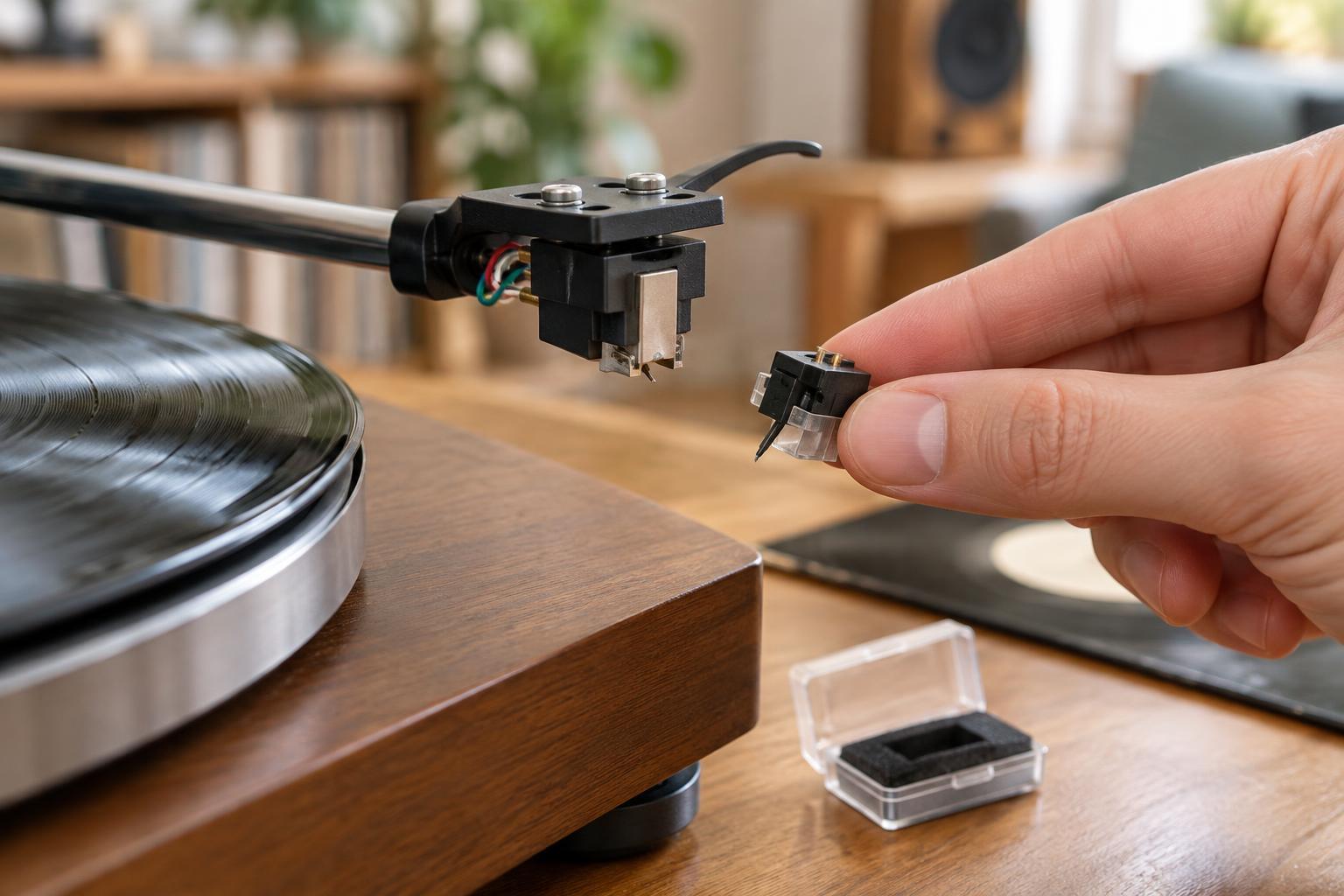
For an ordinary mono microgroove LP or 45, a modern stereo cartridge with a suitable stylus is generally a sensible starting point. Set tracking force and alignment according to the cartridge maker’s guidance, and make sure the stylus is clean and in good condition. A worn or damaged stylus is a greater concern than the mere fact that the record is mono.
Not every old-looking disc is the same format. A 78 rpm record typically needs the correct speed and a stylus intended for its wider groove; a standard LP stylus is not the right default. Some early microgroove records may also reward a different stylus profile or size, but that is an optional refinement rather than a requirement for starting a mono collection. When a record is unfamiliar, check its label, speed and format before lowering the arm.
What about a dedicated mono cartridge?
A modern mono cartridge can be worthwhile if you play a lot of mono records and want a dedicated setup. It may reject unwanted vertical movement at the cartridge rather than relying on a switch later in the chain. Whether the improvement is noticeable depends on the cartridge, the pressing and the rest of the system; it is not a prerequisite for hearing a good mono record.
Be careful with older mono pickups. Some were made before stereo discs became common and may not accommodate the groove movement of a stereo record safely. A modern cartridge sold as mono is not necessarily built the same way, so check its specifications rather than assuming it can or cannot play stereo records. If you alternate frequently between formats, a well-maintained stereo cartridge remains the simplest all-purpose choice.
Listen to the pressing, not just the label
The word “mono” tells you about the intended mix, but records with the same music can differ in wear, mastering and pressing quality. Start with a clean record, confirm the correct speed and listen for problems in both channels. If one channel is much noisier, check the stylus and setup before assuming the record itself is at fault. A mono switch may help with some noise, but it cannot repair groove damage.
For a practical comparison, play a familiar passage at the same volume with the mono setting on and off. Notice whether the sound becomes steadier and whether distracting noise recedes. Then stop adjusting and enjoy the music. A stereo turntable already gives you a straightforward way into mono records; careful handling and attentive listening matter more than assembling a separate system on day one.